Wednesday, January 21, 2009

What Are Fingerprint Minutiae

Fingerprints are known to be unique to every individual. A Minutiae is defined as: the points of interest in a fingerprint, such as bifurcations (a ridge splitting into two) and ridge endings. Types of ridges:
  • ridge endings - a ridge that ends abruptly
  • ridge bifurcation - a single ridge that divides into two ridges
  • short ridges, island or independent ridge - a ridge that commences, travels a short distance and then ends
  • ridge enclosures - a single ridge that bifurcates and reunites shortly afterward to continue as a single ridge
  • spur - a bifurcation with a short ridge branching off a longer ridge
  • crossover or bridge - a short ridge that runs bbetween two parallel ridges


Relevant papers:
www.research.ibm.com/ecvg/pubs/aws-constructive.pdf

MSI vs TIR

This week we read up a little bit more on Multispectral images (MSI) and total internal reflection images (TIR). The way that these MSI scanners are programmed is that they integrate both the capabilities of MSI and TIR images when the user places his or her finger on the scanner. The multispectral images are processed to enhance the fingerprint minutiae. Both MSI and TIR images are then passed into the the SDK for the scanner to detect the minutiae in the fingerprint.

Similarities:
  1. Light Source - provides the light for our sensor to illuminate the platen on top of which the finger rests.
  2. Imaging System – creates the digital imaging array from the image pn the platen.
Differences:
  • MSI - The orientation of the light source and imagers do not exceed any critical angle conditions.
  • TIR – In normal TIR sensors, the light strikes a medium larger than the critical angle.
  • MSI - Has multiple illumination wavelengths,
  • TIR - Monochromatic illumination system.
  • MSI - uses polarizers that are arranged orthogonally to highlight the light that penetrates the skin surface. Once the light penetrates the skin surface, it undergoes multiple scattering events, once the light exits the skin it makes its way to the image array


Full Research Description of this is found in the following papers:
  1. Multispectral Fingerprint Biometrics

  2. Fingerprint enhancement using a multispectral sensor

Monday, January 12, 2009

Related Terminologies

The following terminologies will be commonly used throughout the blog:

Biometric
- Recent studies of methods for recognizing distinct human intrinsic physical or behavioral characteristics.
Fingerprint - Commonly used physical trait in biometric identification
Pruney Fingers - The wrinkles occur in skin after a drawn-out (15-20 min) exposure to water.
TPR - True positive rate (benefits)
FPR - False positive rate (costs)
ROC Curves - Relative Operating Characteristic curve is used as a graphical representation to illustrate a comparison of two operating characteristics (TPR & FPR) as the criterion changes. An example of this curve is illustrated below:


An Introduction to ROC Analysis

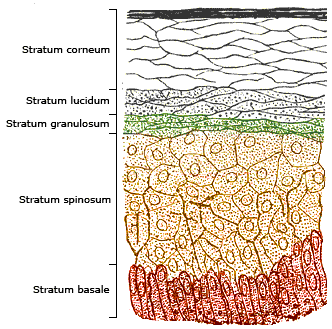
Stratum corneum (or horny layer) - The outermost layer of the epidermis, composed of large, flat, polyhedral, plate-like envelopes filled with keratin which are the dead cells that have migrated up from the stratum granulosum.

Stratum corneum

Pruning - Wrinkling of the skin as immersed in water for prolonged period. A protein, keratin, in stratum corneum which is responsible for skin hydration, absorbs water. So, as toes or fingers are exposed to water for a prolonged time, this layer of skin will develop wrinkles due to its stretchy properties of skin. However, this condition is temporary and it wears off within minutes.

Sunday, January 11, 2009

Research

In order to start our experimental trial, we need to understand the process result in pruney fingers . The duration and temperature are the two parameters that make a difference in our result. So we chose the following paper to complete our understanding of the effect of water aging on fingerprints. 

Effects of water temperature on skin wrinkling

According to this study, the pruning using 40 degree Celsius water will occur in about 5 minutes. For the purpose of our study, we would like to keep the temperature constant to the room temperature. So it will be around 20 degree Celsius. Thus, the duration will increase accordingly.


A similar study shows that the average time to wrinkling in distilled water is 11.5 minutes. The following is a link to this study:

Fingertip Skin Wrinkling the Effect of Varying Tonicity

Experimental Procedure

  1. Register fingerprints of volunteer participants
  2. Make pruney fingers (i.e. leave the same finger in water for 15 min)
  3. Take samples of a wet-wrinkled finger
  4. Test to see if the wet-wrinkled sample matches the normal sample
  5. Then take samples of dried- wrinkled finger
  6. Test for a match
  7. Create a database for indexing and labeling
  8. Use ROC curves for further analyses
*Next class period, we will ask our fellow classmates who are willing to participate in our experimental procedure to register their fingerprints and sign a consent form.
* A consent form will be passed out today

Tuesday, January 6, 2009

Who will benefit from this?!

  • Navy Officers boarding ships
  • Constructor workers
  • People diagnosed with hyperhidrosis disorder

Abstract

The objective of this project is to assess the effects of maritime environment (e.g. sea water, fresh water,etc) on the performance of fingerprint recognition systems. For the purpose of this project, we obtained two kinds of sensors that will perform the data acquisition using two separate methods. To conduct a series of experimental trials, we will recruit volunteers to contribute their fingerprints to the dataset. In the course of this project, we will examine the difference of pruney fingers in fresh water vs. seawater and will address the potential problems that can arise with fingers that dry out after exposure to these environments (e.g. cracks or salt crystal debris). Finally, we will use a graphical plot, receiver operating characteristic (ROC) curve, to illustrate the final result.